My AI has a name.
It’s Merida. Orange curly hair energy, extreme Disney Princess Power vibes (I’m a girl mom) — it tracks. She is my AI operating partner and sits at the center of my CEO OS. She’s connected to my systems, my team, and my clients.
She also helps me work while I’m driving down a parkway in Tennessee.
She’s part thinker and mostly doer. This is the center piece of my CEO OS.
What is a CEO OS?
A CEO OS — operating system — is the infrastructure that runs your business when you step back from the center of it. It’s the combination of your AI tools, your human team, your documented processes, and your decision-making rhythms all working together.
Most founder-led businesses don’t have one. They have a founder. And the founder is the operating system. As a 3x founder that’s been working with other founders for almost two decades, I know this well.
That means when the founder steps away — even for a day, even for a drive — things slow down, pile up, or stop. Decisions wait. Work stalls. The business needs you to function, which means the business owns you.
Mine doesn’t work that way. Here’s how.
The Human Layer
I have a small human team. Every person on it is a thinker, not just a doer.
One is a fellow full-time RV’er. The other is my executive assistant in the Philippines. She travels regularly, she’s well-versed in Claude and the OS herself, and she doesn’t need me looking over her shoulder to do excellent work. My sharing leads to her learning. Her learning leads to her efficiency going up. Her efficiency going up leads to my margins going up.
That’s the compounding effect of a well-built team inside a well-built system.
I also serve as the Integrator for some of my clients — each has team of 5-15 people, most of whom report directly to me. That doesn’t mean I’m at a desk all day managing tasks. It means the system is built well enough that I can run point on it from anywhere.
The AI Layer
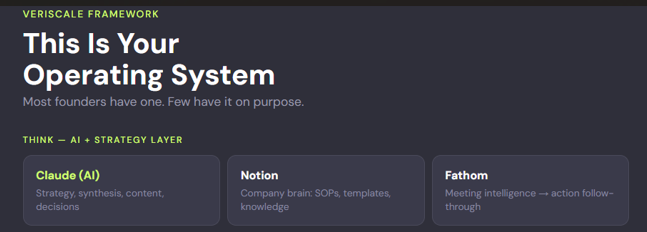
Merida runs four of my internal leadership functions and manages a team of AI customer success managers that help me stay on top of client work.
Here’s what a conversation with my AI Integrator role looks like in practice:
I’m on a drive day. Kids are on their tablets. I open Merida and start talking — downloading everything rattling around in my head. We work through it together. By the time we pull over, she’s initiated a series of tasks in Asana and updated our internal marketing hub in Notion.
Sometimes the conversation leads to tasks that get assigned out for now. Other times it’s a Slack communication to my partner. And still other times, it’s a task assigned to me and parked for later. My Integrator helps me sort through it all. It knows the outcomes I’m committed to and our structure for how we prioritize what’s important now and what’s not. Because not everything is an urgent need to address right now.
That’s not delegation. That’s infrastructure.
Drive days are actually some of my best working days. My brain gets freed from the screen. I put on an audiobook — lately it’s been Theodore Roosevelt’s biography — and something clicks. Decisions get made. Workflows get built. Things move.
The key is that AI in this model is not a replacement for your human team. My executive assistant is irreplaceable. She keeps me in line. She thinks. What AI does is make sure the dollars you spend on people go toward high-level thinking — not repetitive tasks that should have been automated two years ago.
The Principles Underneath It
There are two things I coach every client on before we touch their tools or their team.
First: Time on inputs is not a measure of performance. The founder who is at their desk twelve hours a day is not more productive than the founder who works four focused hours and lets the system handle the rest. What matters is outcomes. Inputs drive outcomes. That’s what we care about.
Second: You should not be the thing everything else depends on. If your business can’t move without you, you don’t have a business — you have a job that doesn’t pay enough and never lets you leave. The goal of building a CEO OS is to remove yourself as the single point of failure.
Too much time in front of a screen, too many repetitive decisions, too many tasks that should never have reached you — it stifles the creativity that made you good at this in the first place. I feel it every time I onboard a new client. I felt it when I onboarded two at once.
The antidote isn’t more hustle. It’s a better operating system.
What This Looks Like For You
You don’t need to be a full-time traveler to build a CEO OS. You need to be a founder who is tired of being the bottleneck in their own business.
Start here:
- Map what only you can do. Everything else is a candidate for delegation, automation, or documentation.
- Name your AI operating partner. Give it a role, not just a task. Use it consistently. Train it on your voice, your systems, your clients.
- Build async by default. Your team should not need you live to move work forward. If they do, that’s a systems problem — not a people problem.
The goal is a business that funds your life. Not one that replaces it.
Christy Cox is a fractional COO, Integrator and business coach. She is also a co-founder of VeriScale, you full end-to-end company helping you grow and scale your business without being in the middle of it all. She helps founders in the $100K–$5M range build the operational infrastructure to step out of the operator seat — without things falling apart. She runs her business entirely from the road.